
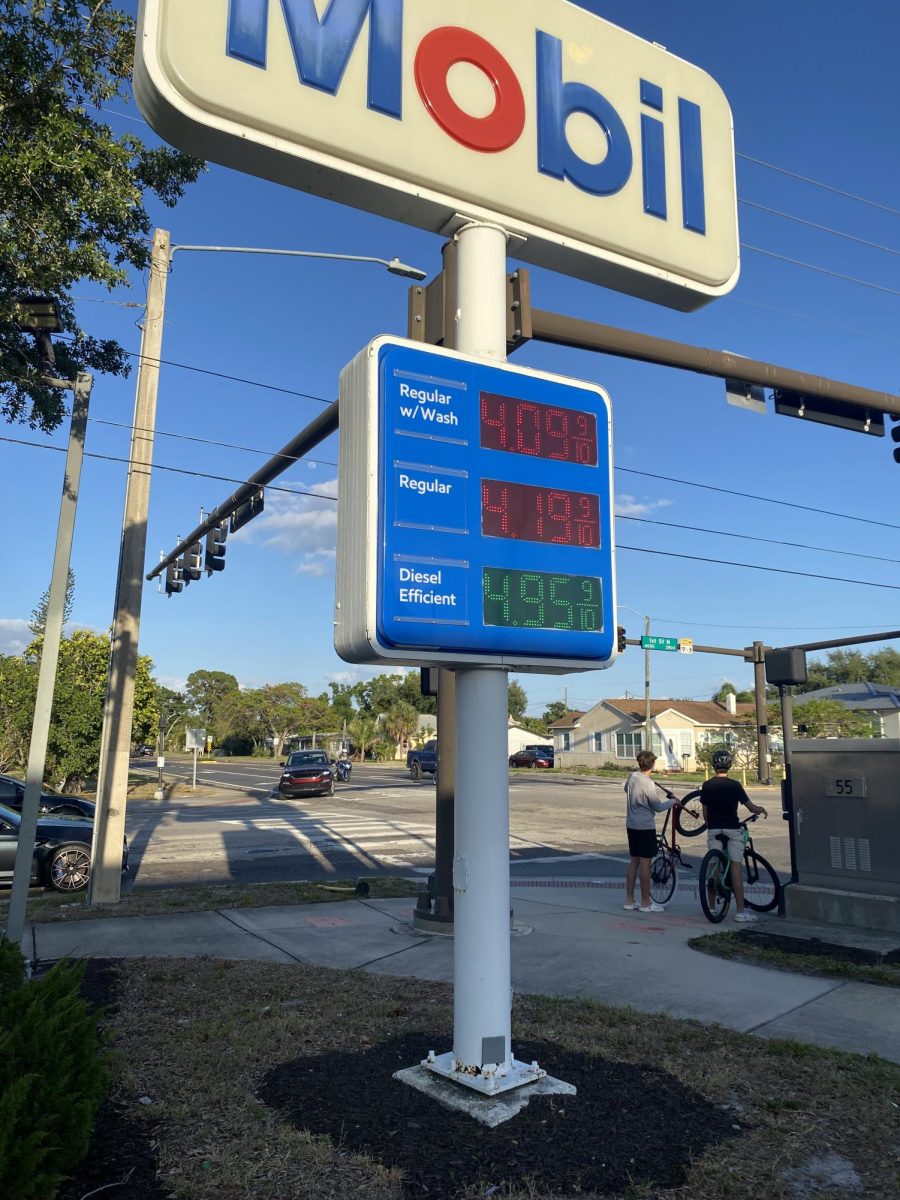
On February 28th, the U.S and Israel launched a joint attack on Iran after a long military buildup in the region, as soon as the missiles launched skyward, so did gas prices.
According to car services Way, prices averaged around $3.20-$3.30 per gallon before the war in St Pete with prices below $3.00 common around St Pete. Now the average price being $3.90 as of April 27th in the Tampa Bay area, luckily climbing down from averages well over $4.00 back in the beginning of March as the Strait of Hormuz, where a majority of U.S and global imports pass through, was shut down by Iran and the main flashpoint in the conflict as fighting intensified during that time.
For many students this has complicated things, most of them pay for gas themselves and the surge in prices has led to some having to rethink how they drive.
For junior Shyam Korabathina it has made him more conscious of how far he is willing to go, saying that “they have made me more cautious about driving distances I don’t need to”
For many however, this hasn’t changed their habits that much. Sophomore Parker Connel notes that he “has not changed the amount I drive” despite the rise in prices.
When asked about whether driving is worth the extra cost, he assured that despite the costs “driving is still worth it, still cheaper than an uber.”
Luckily lately the situation has deescalated to a certain extent, on April 7th a ceasefire between the U.S and Iran was declared, with access to the Strait of Hormuz being the main term for the agreement. Iran agreed to allow access, however, this has been complicated by repeated violations with strikes from both sides continuing and eventually a blockade being implemented by the U.S on April 13th and soon after Iran as well. This dual blockade has essentially reclosed the strait once again to the few ships that were able to navigate through originally through the fragile ceasefire, and now there is uncertainty with whether a deal can be brokered.
IB Global Politics and Economics teacher Angela Hack provided insight into the situation and on how it could plat. She predicts that the “U.S will likely be more willing to apply pressure and hold out for a long time on this war” despite the cost-of-living consequences. She emphasizes that in this situation, the U.S has more of an “individualist mentality that is willing to compromise the increase of energy costs for consumers on an individual scale and companies” and is holding out on the fact that countries caught in the energy crisis on the both sides will push to deescalate as they act more on “national collective interest” and have greater concerns with the scarcity of resources from access to the strait. However, she warned that “countries do have reserves and may be willing to work with Iran to gain access to the strait acting out of that national interest.”
However with the deadline for congress to vote to continue the war approaching on May 2nd due to the war powers resolution act, which allows the president to continue a military operation for 60 days without congressional approval, it is likely that this conflict will continue to drag further despite the need for approval. Mrs. Hack insists that “nothing will happen” because congress simply cannot dole out any consequences to the president if this act is ignored, and they likely will not vote despite the majority in support because “they don’t want to align themselves with the president and damage their approval if the objective was not to be achieved, while also allowing them to align themselves with Trumps in the event that the objectives are achieved” so therefore they simply will abstain from actually doing anything, which adds further uncertainty to the situation.
This uncertainty is likely to keep gas prices from returning to prewar levels for a long time, however the advent of the ceasefire in the first place appears to have driven prices down locally from their peak in mid-march, but in the midst of this tension and uncertainty with the ceasefire and the blockades prices have slowly trended back up for the bay area according to bay news 9, with a gradual rise of 10 cents being recorded over the past few weeks. Mrs. Hack exclaims that is likely due to the uncertainty and probability of the length of the conflict and the ability for ships to pass through Hormuz, saying that “most companies aren’t willing drop prices due to the uncertainty of the situation and that likely will continue for a long time”
Despite the uncertainty and potential longevity of the situation, some students are relaxed and insist that the costs aren’t too dire for them. Senior Noah Fortenbury assures that “he is not worried at all” and adding that “gas prices are always going to fluctuate and eventually it’ll go back down”